
MANDELA MAKES HIS IMPRINT ON THE WORLD
By: Hope Wilkos, Writer/Blogger
People around the world have not been mourning the death of a leader today but instead they are celebrating the life of Nelson Mandela.
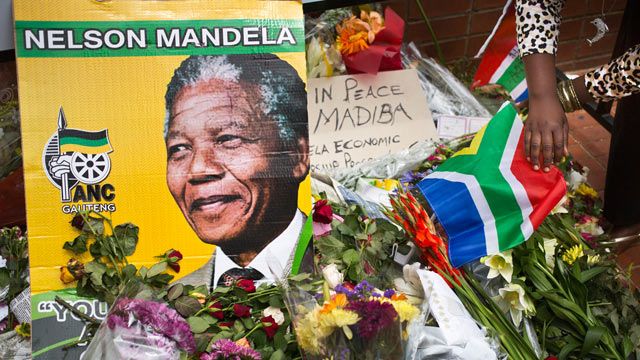
The sheets of rain fell heavily, making nature not an obstacle on this day of tribute, but instead, a challenge that tens of thousands did not let come between them and the man of a vision and the belief and reality of the abolishment of apartheid.
South Africa needed a stadium in order to hold all those that felt that Nelson Mandela had touched their lives in significant ways. Johannesburg’s Soccer City Stadium was the venue for the memorial service to take place on Tuesday, December 10, 2013. Mandela lived to be 95 years of age and passed away last week after a battle with a lung infection for the past few months.
Not only did citizens flock to the stadium to remember and worship their past leader, but 100 World Leaders such as President Barack Obama, Prime Minister David Cameron, Afghan President Hamid Karzai, Cuban President Raul Castro and many more also traveled hundreds of miles to be part of this memorial. The Clinton and Bush families also were present for the memorial service.

Nelson Mandela’s life was a legacy. He was the leader of the anti-apartheid struggle and he became one of the most influential men in history. In addition to a large and loving family, he took his country of South Africa as his second family, occupying much of his time with his people. After being set free from 27 years of imprisonment, Mandela gravitated towards politics and definitely found his true calling.
As the world caught a glimpse of Raul Castro and President Barack Obama shaking hands for a brief moment, it was a symbolic gesture of just how far we have come in the anti-apartheid movement.
President Obama viewed Mandela as one of his mentors and he took to the podium to express his heartfelt condolences and reminisce back on the influence that Nelson Mandela had on him personally. Here are some excerpts from his speech today which was met with cheers and shouts of joy:
“It is hard to eulogize any man – to capture in words not just the facts and the dates that make a life, but the essential truth of a person – their private joys and sorrows; the quiet moments and unique qualities that illuminate someone’s soul. How much harder to do so for a giant of history, who moved a nation toward justice, and in the process moved billions around the world.
Given the sweep of his life, and the adoration that he so rightly earned, it is tempting then to remember Nelson Mandela as an icon, smiling and serene, detached from the tawdry affairs of lesser men. But Madiba himself strongly resisted such a lifeless portrait. Instead, he insisted on sharing with us his doubts and fears; his miscalculations along with his victories. “I’m not a saint,” he said, “unless you think of a saint as a sinner who keeps on trying.”
It was precisely because he could admit to imperfection – because he could be so full of good humor, even mischief, despite the heavy burdens he carried – that we loved him so. He was not a bust made of marble; he was a man of flesh and blood – a son and husband, a father and a friend. That is why we learned so much from him; that is why we can learn from him still. For nothing he achieved was inevitable. In the arc of his life, we see a man who earned his place in history through struggle and shrewdness; persistence and faith. He tells us what’s possible not just in the pages of dusty history books, but in our own lives as well.
Mandela showed us the power of action; of taking risks on behalf of our ideals. Perhaps Madiba was right that he inherited, “a proud rebelliousness, a stubborn sense of fairness” from his father. Certainly he shared with millions of black and colored South Africans the anger born of, “a thousand slights, a thousand indignities, a thousand unremembered moments…a desire to fight the system that imprisoned my people.”
Mandela understood the ties that bind the human spirit. There is a word in South Africa- Ubuntu – that describes his greatest gift: his recognition that we are all bound together in ways that can be invisible to the eye; that there is a oneness to humanity; that we achieve ourselves by sharing ourselves with others, and caring for those around us. We can never know how much of this was innate in him, or how much of was shaped and burnished in a dark, solitary cell. But we remember the gestures, large and small – introducing his jailors as honored guests at his inauguration; taking the pitch in a Springbok uniform; turning his family’s heartbreak into a call to confront HIV/AIDS – that revealed the depth of his empathy and understanding. He not only embodied Ubuntu; he taught millions to find that truth within themselves. It took a man like Madiba to free not just the prisoner, but the jailor as well; to show that you must trust others so that they may trust you; to teach that reconciliation is not a matter of ignoring a cruel past, but a means of confronting it with inclusion, generosity and truth. He changed laws, but also hearts.
For the people of South Africa, for those he inspired around the globe – Madiba’s passing is rightly a time of mourning, and a time to celebrate his heroic life. But I believe it should also prompt in each of us a time for self-reflection. With honesty, regardless of our station or circumstance, we must ask: how well have I applied his lessons in my own life?
It is a question I ask myself – as a man and as a President. We know that like South Africa, the United States had to overcome centuries of racial subjugation. As was true here, it took the sacrifice of countless people – known and unknown – to see the dawn of a new day. Michelle and I are the beneficiaries of that struggle. But in America and South Africa, and countries around the globe, we cannot allow our progress to cloud the fact that our work is not done. The struggles that follow the victory of formal equality and universal franchise may not be as filled with drama and moral clarity as those that came before, but they are no less important. For around the world today, we still see children suffering from hunger, and disease; run-down schools, and few prospects for the future. Around the world today, men and women are still imprisoned for their political beliefs; and are still persecuted for what they look like, or how they worship, or who they love.
We, too, must act on behalf of justice. We, too, must act on behalf of peace. There are too many of us who happily embrace Madiba’s legacy of racial reconciliation, but passionately resist even modest reforms that would challenge chronic poverty and growing inequality. There are too many leaders who claim solidarity with Madiba’s struggle for freedom, but do not tolerate dissent from their own people. And there are too many of us who stand on the sidelines, comfortable in complacency or cynicism when our voices must be heard.
The questions we face today – how to promote equality and justice; to uphold freedom and human rights; to end conflict and sectarian war – do not have easy answers. But there were no easy answers in front of that child in Qunu. Nelson Mandela reminds us that it always seems impossible until it is done. South Africa shows us that is true. South Africa shows us we can change. We can choose to live in a world defined not by our differences, but by our common hopes. We can choose a world defined not by conflict, but by peace and justice and opportunity.”
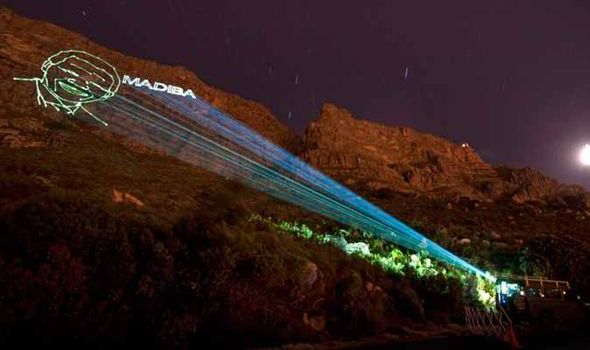
Mandela’s family also gave eulogies including some of his grandchildren. Other dignitaries and politicians and past presidents gave their remembrances of the first black President of South Africa who took to the position in 1994. Seen paying tribute to Mandela and his legacy was former Archbishop Desmond Tutu, the lovely Charlize Theron, a native South African, supermodel Naomi Campbell and Bono of the musical group, U-2, who is so revered by so many for his advocacy and efforts to achieve world peace. As you looked around the stadium, portraits of the many faces of Nelson Mandela could be seen in bright colors, amazing replicas of the man that united enemies across the political and racial divide.
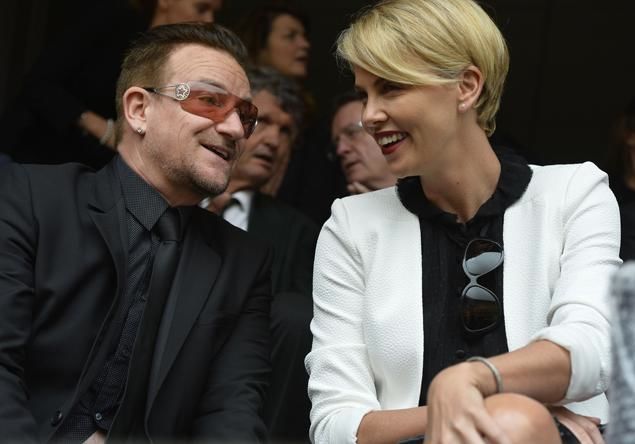
It has already been almost a week of celebratory tributes of a man that set the bar for peace and the end to apartheid. He became a role model to thousands and it is difficult to close this chapter of the book in South Africa. Perhaps we will put a bookmark there for now. Nelson Mandela will not totally be put to rest until this coming Sunday, December 15, 2013, when a state funeral will be held for him in his hometown of Qunu.

PHOTO CREDITS: Roberto Schmidt (AFP/Getty Images), Yves Herman (Reuters), Odd Andersen (Getty Images)and Guardian.com



Comments are closed.