
THE PHENOMENON OF THE MOON
By: Hope Wilkos, Writer/Blogger Photographer: George Whylie Videographer: Maxine NolanMother Nature works in the most mysterious of ways. We take much of her beauty for granted.
The month of May brought some astonishing wonders to our sky. One Saturday evening started just like any other, however, the moon powerfully began to rise in the night sky like a ball of fire. The brightness almost turned the night to day. This phenomenon was know as “Supermoon”.
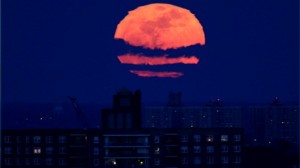
Nothing had even come close to this majesty in nearly decades. The moon was extremely close to the earth thus creating this magic. It was the talk of our social media outlets. When the moon is closest to Earth, it is 14% larger and 30% brighter than when it is farthest from the planet.
Some astronomers and scientists associate unusual weather patterns such as earthquakes and storms with the “Supermoon”. It seemed that in past instances, like in 1955, 1974, 1992 and 2005, extreme weather followed the so-called “Supermoon”. Unfortunately, as you can surmise from these dates, this is not a common occurrence. Therefore, this has not been a proven fact as of yet.
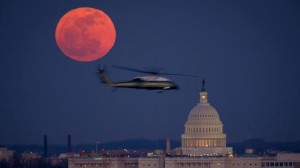
However, the closer the moon gets to the Earth, the gravitational effect causes higher tides although there were no warnings of any kind or any flooding or extreme conditions. The best time to look at this huge moon is in the early evening as the moon is rising.
No sooner had this happened than on the afternoon of May 20th, the moon entered its new phase, the passing between the Earth and the Sun. The end result became a solar eclipse that was visible from the Oregon-California border to Lubbock, Texas. So at this time instead of the moon increasing in size, it decreased in size. This brought about the “Annular Eclipse”.
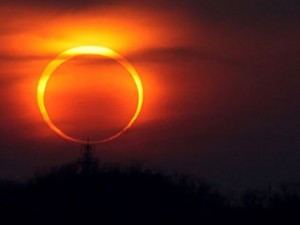
The definition of this marvel is when an extremely bright ring of the sun surrounds the black disc of the moon. Never look directly at this entrancing light as it can be blinding and is only meant to be viewed from a telescope or with binoculars. Although this was somewhat of a partial eclipse, stay tuned all you astronomy lovers because a total eclipse is due right about November 13th later this year. However, the bad news is that it will only be visible from Australia and the South Pacific to our dismay.
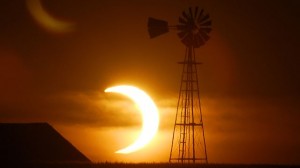
PHOTO CREDITS: ABC News and A/P Photo



Comments are closed.