
Second Estimate of GDP for Qtr 1 2014
By: Hope Wilkos, Writer/Blogger
As we come to the close of yet another month, it brings us ever so much closer to the middle of 2014. It is once again time to reanalyze the Gross Domestic Product or GDP for the first quarter of 2014 which is now behind us. Although full credence cannot be entirely put into the findings which remain volatile, it was promising to find that consumer spending inched slightly upwards along with business fixed investment. That was offset by a small downward swing to net exports and state and local purchases. Having a large influence over the customer spending was the unusually bitter winter weather that most parts of the nation experienced in the first two months of the year. Once March and April were upon us, a reevaluation took place using job, manufacturing and housing factors and data along with other indicators which helped to show just where the economy will land.
As is customary, there were key takeaways from the conclusions based on the research that entailed.
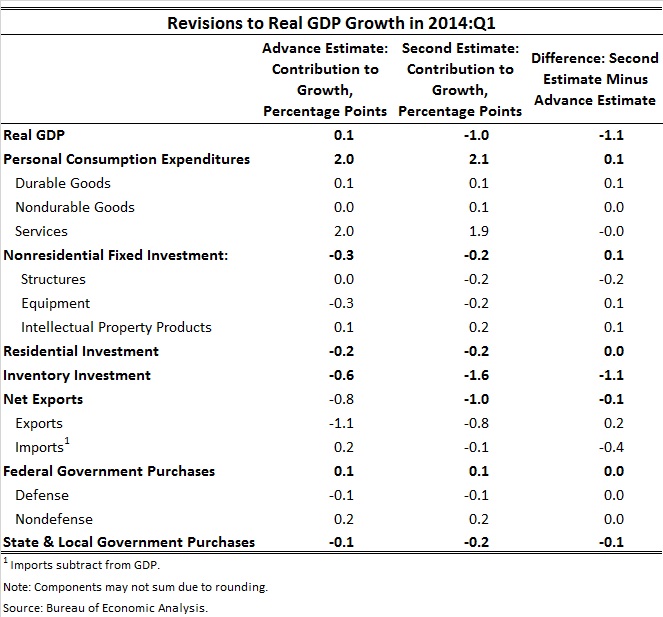
1. Real gross domestic product (GDP) fell 1.0 percent at an annual rate in the first quarter of 2014, according to the second estimate from the Bureau of Economic Analysis. This drop follows an increase of 3.4 percent annual pace in the second half of 2013. Looking at the various components of GDP, consumer spending grew at a rapid pace, mainly reflecting sharp increases in health care and utilities consumption, while the other elements of consumer spending on net rose only slightly. Consumer spending on food services and accommodations fell for the first time in four years, one of several components that was likely affected by unusually severe winter weather. Exports and inventory investment, two particularly volatile components of GDP, also subtracted from growth.
 Real GDP Growth from 2007 – 2014
2. The downward revision to real GDP growth was almost entirely due to a downward revision to the volatile inventory investment component; revisions to the other components were small and offsetting. The contribution of inventory investment to growth was revised down a full percentage point, from -0.6 percentage point in the advance estimate to -1.6 percentage point in the latest estimate. Consumer spending and business fixed investment were revised up slightly, while net exports and State and local government spending were revised down slightly.
3. The first quarter of 2014 was marked by unusually severe winter weather, including record cold temperatures and snowstorms, which explains part of the difference in GDP growth relative to previous quarters. The left chart shows the quarterly deviation in heating degree days from its average for the same quarter over the previous five years. By this measure, the first quarter of 2014 was the third most unusually cold quarter over the last sixty years, behind only the first quarter of 1978 and the fourth quarter of 1976. In addition, there were four storms in the first quarter that rated on the Northeast Snowfall Impact Scale (NESIS). The right chart shows that no quarter going back to 1956 had more than three such storms.
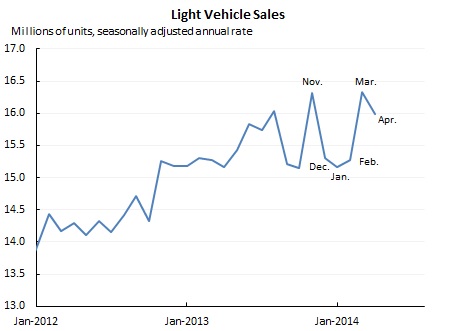
4. Within the first quarter, several key indicators were lower in January and/or February before rebounding strongly in March, suggesting that the severe weather had a disruptive effect that only began to abate at the end of the quarter. Light vehicle sales, average weekly hours, core retail and food service sales, and core capital goods shipments dipped starting in December and/or January before bouncing back in March, and so were left little changed for the quarter as a whole. One outside group has estimated that the elevated snowfall in the first quarter slowed the annual rate of GDP growth by 1.4 percentage point, with all of that lost activity to be made up in the second quarter.
Additionally, it is worth noting that consumer spending on utilities surged more than 40 percent at an annual rate in the first quarter, the largest increase on record (with data back to 1959). While this weather-related jump in utilities spending added to GDP growth, it was likely more than offset by the constraining effect of severe weather on other categories, including other components of consumer spending (like autos, household furnishings, and restaurants), some components of private and public fixed investment, and exports.
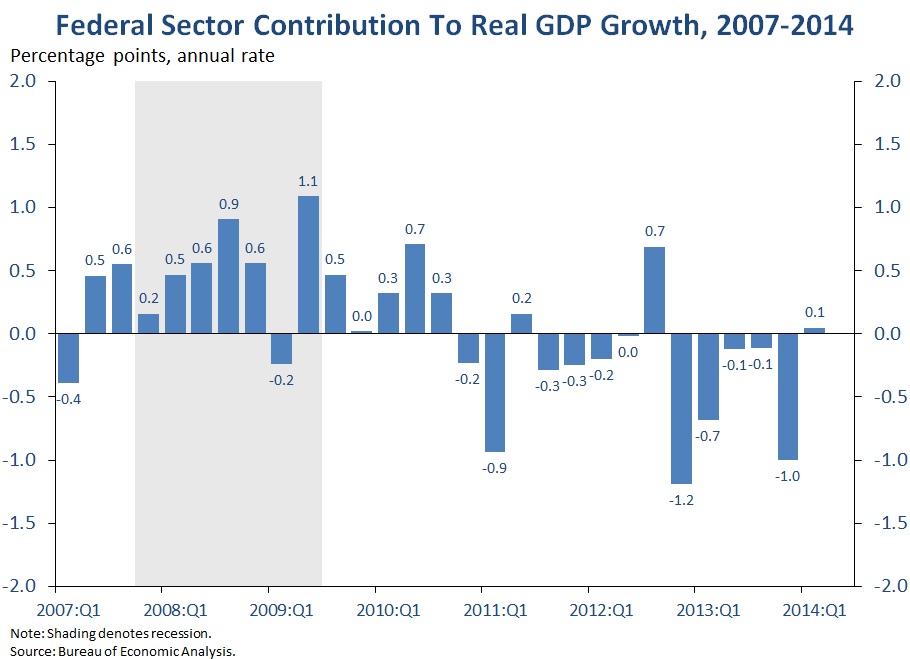
5. The federal sector made a small positive contribution to growth for the first time in over a year, in part because the effect of the shutdown in the fourth quarter reversed. The Bureau of Economic Analysis (BEA) reported that in the fourth quarter, federal worker furloughs resulting from the government shutdown directly reduced GDP growth by 0.3 percentage point at an annual rate; other effects of the shutdown (including reduced government purchases of goods and services) also likely contributed to the large 1.0 percentage point negative contribution from the federal government.
In the first quarter of 2014, the federal sector made a small (0.05) percentage point positive contribution to growth, in part due to the return to a full quarter of undisrupted federal employee work hours. Federal spending is subject to a number of influences, including the winding down of overseas military operations, the withdrawal of temporary support measures enacted earlier in the recovery, and in 2013, the sequester. The budget agreement reached late last year should create a more neutral fiscal climate in 2014 than in 2013, and while there is still a need to do more to invest in growth, the reduced fiscal drag is a key reason that outside forecasters expect growth to strengthen over the remainder of the year.
We are anxious to see what Qtr 2 2014 results bring with the hopes that the ensuing results are positive once again.
It was also announced today that White House Office Press Secretary, Jay Carney, resigned and Josh Earnest, a familiar face, will be taking over that position in June. Best of luck to both Mr. Carney and Mr. Earnest.
The information on the GDP was released by Jason Furman, Chairman of the Council of Economic Advisers.



Comments are closed.