
THE FEBRUARY EMPLOYMENT SITUATION 2014
By: Hope Wilkos, Writer/Blogger
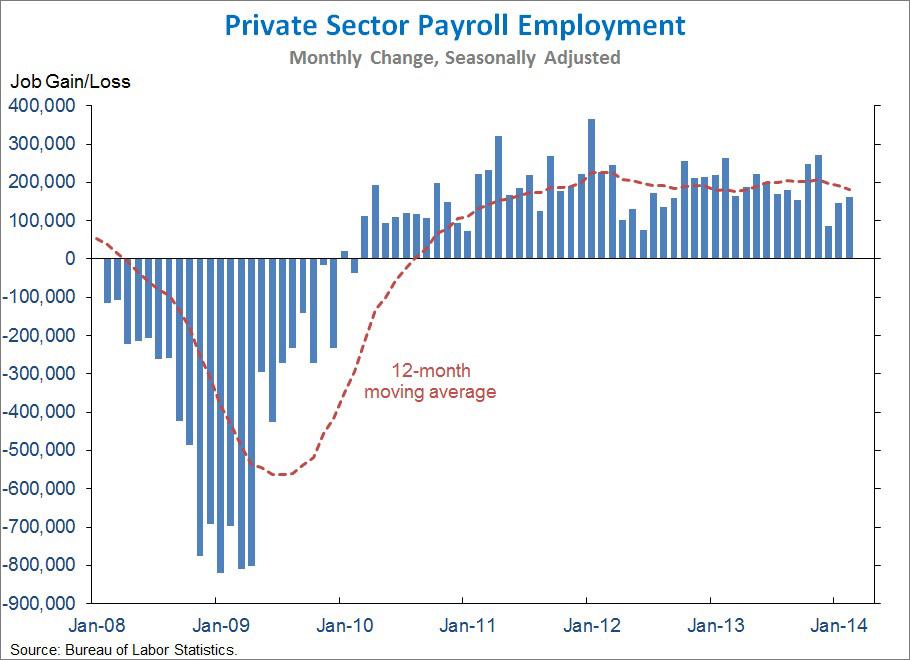
Awaiting the release of the statement on the employment situation for February, many speculated that there would be no change due to the problematic weather conditions. When the numbers were released, there was no big surprise. The month of February was the 48th month in a row where the private sector employment grew, a result of businesses adding 8.7 million jobs over the time period. Job growth seemed to pick up the pace in February as compared to December and January. Still, even taking this into consideration, wages are moving up at a slow pace. As we found last month, there are five key takeaways based on the information released.
1. It is promising news that the private sector has added 8.7 million jobs for the last 48 months straight. Nonfarm payroll employment rose by 175,000 in February, and 162,000 of that increase was in the private sector. Over the past 12 months, private employment has rose by 2.2 million (average of 183,000 a month).
2. A blatant obstacle on the results, a major snowstorm hit the east coast during the time frame of February 11 to February 14, which coincided with the exact reference week that the household and establishment surveys were to take place and this caused millions of workers to miss work during those days. What this equated to was 6.9 million nonagricultural workers working part-time instead of full-time during this week due to bad weather which is the second most in any month over the past 20 years. Another 600,000 nonagricultural workers missed work at that time for the very same reason, twice as many as last February. Because these workers continued to be counted as employed in the household survey, it had no impact on the unemployment rate, while on the other hand, the unusual increase in weather-related absences had some effect on payroll employment and average weekly hours as measured in the establishment survey.


3. Recent first-reported monthly job estimates have been a bit less volatile than they were for much of the 2000’s expansion period. Looking over the last two years, the standard deviation of the first reported monthly change in payroll employment is 44,000, which indicates that about two-thirds of the reports will fall within the average of 146,000 plus or minus 44,000. The variation is due to a combination of true fluctuations in the underlying economy as well as the imprecision of measuring monthly job changes. Over this same period, revisions following the first report raise both the average (to 179,000) and the standard deviation (to 53,000).

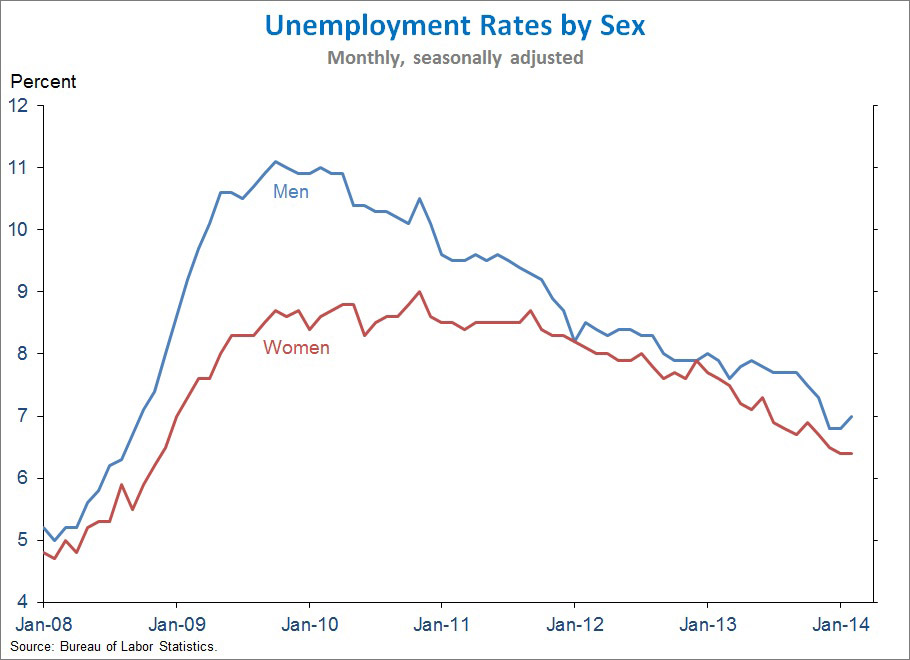
4. In recognition of Women’s History Month, it is important to note that the female unemployment rate has been steady at 6.4% in each of the last two months which is also the lowest since November 2008. The lack of an immediate recovery in female unemployment is likely due, in part, to the lower starting-off point and job cuts in state and local governments over the period which has disproportionately affected teachers. Since the end of 2011, the female unemployment rate has fallen 1.9 percentage points. The President has been working to look for ways to build on the progress and create more and better economic opportunities for women and doing so by combating discrimination, ensuring equal pay for equal work and promoting workplace flexibility.
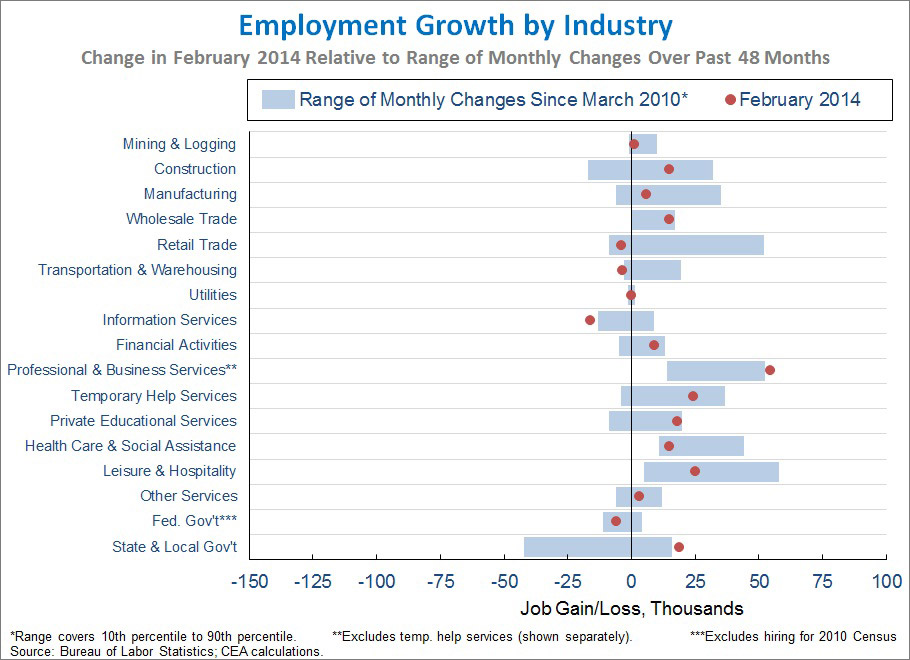
5. If you look across all industries, professional and business services and state and local government had strong months in February. The employment in those areas rose by 55,000, the third best month of job growth over the last 4 years (excluding temporary help services), while state and local government employment rose by 19,000, the 4th best month of job growth over the last 4 years. Information services had a weaker month, falling by 16,000, and this may have been directly related to the decline in the unstable motion picture and sound recording industries category. Manufacturing climbed up just a bit by 6,000 and has not added 83,000 jobs over the last 7 months.
The President is working to make this an even brighter picture by putting out a budget that seeks to change issues of investing in education, job training, innovation, expanding tax credits for working Americans, and by extending the emergency unemployment benefits that has expired for 2 million Americans. He has pushed the Congress to take action on these proposals while at the same time promising to take action on his own wherever possible to support job growth and economic opportunity.
STATEMENT RELEASED BY THE WHITE HOUSE, Office of the Press Secretary.



Comments are closed.