
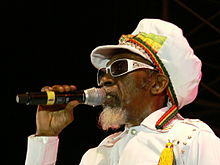
Bunny Wailer, (born Neville O’Riley Livingston, April 10, 1947, Jamaica), also known as Bunny Livingston and affectionately as Jah B,[1] is a singer songwriter and percussionist and was an original member of the world-famous Reggae Group, The Wailers, along with Bob Marley and Peter Tosh. He is widely regarded as a musical legend and is considered one of the longtime standard bearers of reggae music. Newsweek has labeled Bunny as one of the three most important musicians in world music.
Bunny Wailer and Bob Marley were raised in the same household as stepbrothers.[2] Bunny’s father Thaddeus “Toddy” Livingston lived with Bob Marley’s mother Cedella Booker and they had a daughter named Pearl Livingston.
As he was by some way the least forceful of the trio, he tended to sing lead vocals less often than Marley and Tosh in the early years, but when Bob Marley left Jamaica in 1966 for Delaware, to be replaced by Constantine “Vision” Walker, he began to record and sing lead on some of his own compositions, such as “Who Feels It Knows It”, “I Stand Predominant” and “Sunday Morning”. Gospel was very influential on his music as was the soul of Curtis Mayfield. In 1967, he recorded “This Train”, based on a gospel standard for the first time at Studio One.
As the Wailers moved from producer to producer in the late 60’s, he continued to be underused as a writer and lead vocalist, although he sang lead on “Riding High”, and on one verse of the Wailers’ Impressions-like “Keep On Moving”, both produced by Lee Perry. By 1973, each of the three founding Wailers operated their own label, Marley with Tuff Gong, Tosh with H.I.M. Intel Diplo, and Bunny Wailer with Solomonic. He sang lead vocals on “Reincarnated Souls”, the B-side of the Wailers first Island single of the new era, and on two tracks on the Wailers last trio LP, “Burnin'” , “Pass it On” (which had been cut as a sound-system only dub plate five years earlier) and “Hallelujah Time”. By now he was recording singles in his own right, cutting “Bide Up”, “Arab Oil Weapon” and “Life Line” for his own label.
Bunny Wailer toured with the Wailers in England and the United States, but soon became reluctant to leave Jamaica. He and Tosh became more marginalized in the group as the Wailers became an international success, and attention was increasingly focused on Marley. Bunny subsequently left the Wailers to pursue a solo career, which continues in the present.
After leaving the Wailers, Bunny became more focused on his spiritual faith. He identified with the Rastafari movement, as did the other Wailers. He has also written much of his own material as well as re-recording a number of cuts from the Wailers catalogue. Bunny Wailer has recorded primarily in the roots style, in keeping with his often political and spiritual messages. The album Blackheart Man is a good example of his roots reggae style, while “Sings the Wailers” successfully reworks many of The Wailers songs with the backing of top Jamaican musicians, Sly and Robbie. He experimented with disco on his album ‘Hook Line & Sinker’. He has also had success recording in the typically apolitical, more pop dancehall style. He has outlived his contemporaries in a culture where death by violence is commonplace.
Bunny Wailer was both the quietest and most spiritually creative of the Wailers. However, he also had a dancehall/Rockers edge that was best exemplified by the album “Bunny Wailer Sings the Wailers” in which he re-interprets some of the Wailers material as a solo Roots singer backed by a solid Sly & Robbie based Roots reggae grouping. The album was produced by Bunny Wailer, recorded at Harry J studios. Some of these tracks are re-worked classic Wailers tracks (e.g. Dreamland – a cover of El Tempos’ My Dream Island with slightly reworked lyrics that became Bunny’s signature song. This was first recorded in 1966 by Clement Coxsone Dodd, later 1970 with Lee ‘Scratch” Perry and released as a 7″ in 1971 with a U-Roy version on the B -Side). Another classic is Dancing Shoes, first recorded in the mid 1960s as a driving Ska/Soul classic with Bunny Wailer as lead vocal.
As a tribute to his success, Bunny Wailer has won the Grammy Award for Best Reggae Album in 1990, 1994 and 1996.
The launch of The Jamaica Music 50 and The Wailers 50th Anniversary Campaign 2012-2014
Jamaica Music 50 is a multi-year celebratory campaign to understand the creative genius, technological innovations and visions of key entrepreneurs that created an industrial basis for the development of the uniquely Jamaican music forms that revolutionized music in Jamaica and around the world in the 20th century.
Today, Bunny resides in Kingston and on a farm located in the interior of Jamaica (Saint Thomas), according to Bob Marley’s official website. Bunny Wailer and Beverley Kelso are the only surviving members of the original Wailers. In recent years, Bunny has attracted controversy for his outspoken views on women and homosexuality. Bunny still keeps going strong these days. With the release of a new album, he is revitalizing his catalogue and once again captivating his fans with his reggae music.
As Bunny Wailer can be heard saying, “The Best of the Wailers is yet to come”…………..



Comments are closed.