
THE DECEMBER 2012 EMPLOYMENT SITUATION
By: Hope Wilkos, Writer/Blogger Photographer: George Whylie Videographer: Maxine NolanIt is no surprise that the employment situation in December stayed the same as November. Figures were released this morning showing the unemployment rate remaining at 7.8%. Originally, November figures put the month at a rate of 7.7% but as a result of BLS’s annual update of seasonal factors, that rate was changed to 7.8%. For both months, the labor force participation rate was 63.6%. Over the period of the last year, the unemployment rate has decreased by 0.7 percentage points as a result of growing employment. The labor force participation rate has remained unchanged.
The Bureau of Labor Statistics shows that the private sector added 168,000 jobs in December. The total non-farm payroll employment rose by 155,000 jobs last month. The economy has added private sector jobs for 34 consecutive months for a total of 5.8 million jobs. This also takes into account the preliminary benchmark revision.
Survey results show the health care and social assistance industry added 55,000 jobs, restaurants and bars added 38,000 jobs, construction added 30,000 jobs and manufacturing added 25,000 jobs. The most significant sector to benefit has been manufacturing which added jobs in 30 of the last 35 months which equates to half a million jobs which is the most for any period since the late 1980’s. Payrolls rose in residential and non-residential construction jobs giving some hope that the economy is beginning to get back on track.
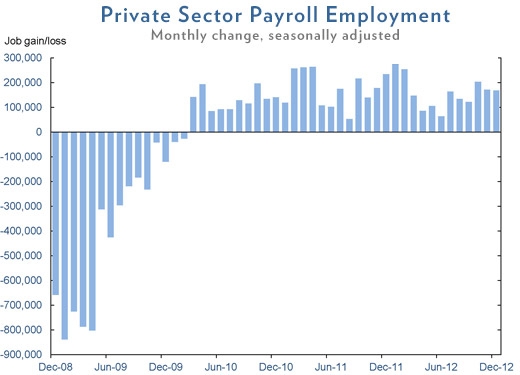
Some of the less optimistic sectors include retail trade which lost 11,300 jobs following gains totalling 161,300 over the previous 4 months. Government lost 13,000 jobs in December (mostly in local government education which lost 11,500 of the jobs or 88%). Unfortunately, 294,400 jobs have been lost in the local government education sector since November of 2009.
Earlier in the week, the American Taxpayer Relief Act was passed. More than 98% of Americans and 97% of small businesses have assurance that their income tax will not rise. Unemployment insurance was also extended for 2 million Americans still looking for work. Companies will receive tax credits for the research they do and continue to have tax incentives to accelerate investment in their businesses. The deficit is further reduced by $737 billion over the next decade as income tax cuts for the top 2% of earners will expire.
The key takeaway from this recent statement is to move towards a more sustainable federal budget balancing revenue and spending while protecting critical investments in the economy and essential support for the most vulnerable of citizens.
STATEMENT RELEASED BY ALAN B. KRUEGER, CHAIRMAN OF THE COUNCIL OF ECONOMIC ADVISERS



Comments are closed.