
DECEMBER 2013 EMPLOYMENT UPDATE
By: Hope Wilkos, Writer/Blogger
The year 2013 proved to be gaining progressive strength as we continue to pursue economic recovery but 2013 didn’t exactly end with a bang. December’s job growth was a bit lackluster from what was expected but the focus needs to remain on fixing the economy for the long-term. Over the course of 2013, 2.2 million private sector jobs were added and a 1.2% point decline was the end result for the year.
There are five key points that should be noted as we discuss the December 2013 employment results:
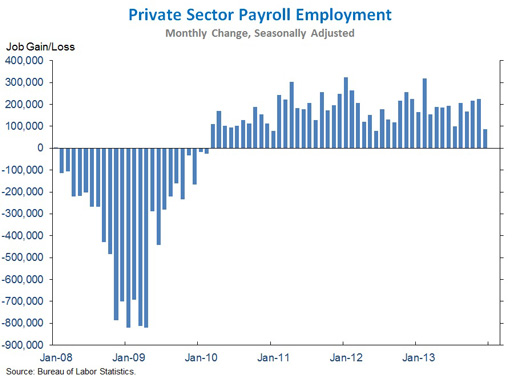
1. America’s resilient businesses have added jobs for 46 consecutive months, with private sector employment increasing by 8.2 million over that time frame. Nonfarm payroll rose by 74,000 in December due to an 87,000 increase in private employment. With the revisions in the figures that took place for October and November, it means that private employment has risen by an average of 177,000 per month.
The Council of Economic Advisers estimates that extending the Emergency Unemployment Compensation (EUC) program through 2014 would lead to an additional 240,000 jobs over the course of the year, because the benefits sustain the purchasing power of recipients who support local businesses and their suppliers. This projection is similar to the central estimate released by the Congressional Budget Office.
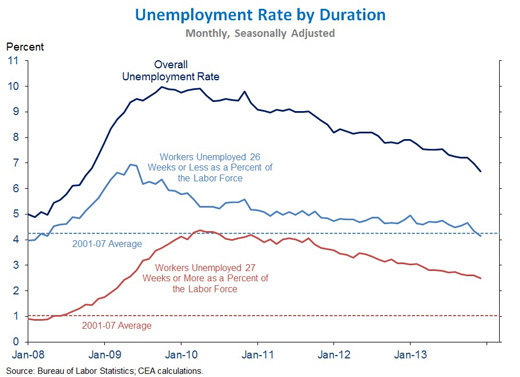
2. The overall unemployment rate declined to 6.7% in December, the lowest since October 2008, but the lingering elevation in the unemployment rate is due to the large number of persons unemployed for over 27 weeks. Those that were unemployed for 26 weeks or less represent 4.1% of the labor force. The long-term unemployment rate is still two-and-a-half times what it was during the 2000s expansion (2.5% in December 2013 vs. 1.0% on average before the recession). This only goes to prove that it is critical to bring down the unemployment rate while supporting people who are still struggling to find jobs.
3. With the expiration of the EUC program at the end of December, the share of the unemployed receiving jobless benefits is likely to fall to the lowest on record. For the 12 months that ended November 2013, 26% of unemployed workers received jobless benefits through regular programs, compared to 36% on average from 1986 to the beginning of the Great Recession in December of 2007. The EUC program provided benefits to 14% of the unemployed over these particular 12 months. At its peak, those receiving the benefits were just over 35%. It is interesting to note that for every job opening, there are 2.8 job seekers.

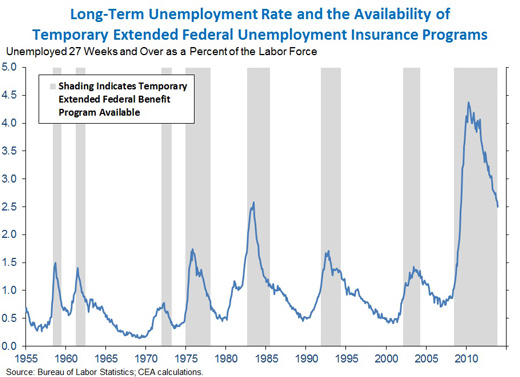
4. As we ended the year, the long-term unemployment rate remained elevated and recent temporary federal unemployment insurance programs have only expired when the long-term unemployment rate was roughly half of what it was now. The long-term unemployment rate (unemployed 27 weeks or more) was 1.3 percent when temporary extended federal unemployment insurance programs were terminated in April 1994 and March 2004. As of December 2013, it was 2.5 percent, nearly twice as high, another reason that failing to reinstate the EUC program would represent an unprecedented blow to the support traditionally offered to the unemployed as the economy heals. Moreover, with the average duration of unemployment at 37.1 weeks, the EUC program, which provides benefits beyond 26 weeks, is filling an important gap.
5. It is safe to say that the unemployment rate is trending downward with declines for key demographic groups. The overall unemployment rate fell 1.2 percentage points from December 2012 to December 2013. It averaged 7.0% for the fourth quarter, below the 7.6 percent rate that was expected by the Blue Chip panel of forecasters at the end of 2012. Unemployment rates also declined over the course of 2013 for women (1.3 percentage points), teenagers (3.8 percentage points), African-Americans (2.1 percentage points), and Hispanics (1.2 percentage points). Similarly, since the overall unemployment rate peaked at 10.0% in October 2009, these rates have all shown marked declines. At the same time, unemployment for each of these groups is still above where it was prior to the Great Recession, underscoring that it is critical not just to take steps to speed the recovery, but also to ensure that growth is inclusive and hardworking Americans are not left behind.

However, now Congress has allowed extended unemployment insurance to lapse at the end of 2013, cutting off the critical lifeline to all those workers who have lost their jobs through no fault of their own and they still search diligently for work. These unemployment insurance benefits are a strong necessity and should be a top priority as we begin 2014.
STATEMENT RELEASED BY THE WHITE HOUSE Office of the Press Secretary



Comments are closed.