
DON’T LET OUR REEFS DISAPPEAR
By: Hope Wilkos, Writer/Blogger
It can be said that the tranquil coral reefs are some of the most precious gifts that Mother Nature has bestowed upon us. Our marine ecosystems depend on the reefs to thrive in a healthy environment and in this way the process of evolution continues into the future. Unfortunately, reefs are now being negatively impacted by a few factors.
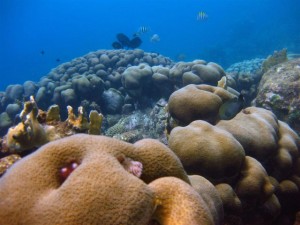
The threat of global climate change, increased ocean acidity (over 30% more now than in the past) and warmer water temperatures and taking their toll on our cherished reefs. As they begin to slowly dissolve, there is less protection from storm surges. Carbon dioxide makes the water more acidic and breaks down the corals’ mineral skeletons and the sea floor beds cannot neutralize fast enough to build their calcium structures. It will be difficult for the corals to continue to adapt to this situation for much longer. Corals will need to expend a good deal of energy to keep their skeletons from dissolving into seawater. If this path were to continue, reefs may dissolve by the middle of the century but nobody has a crystal ball to be able to predict how fast or how slow the change will occur.
It has been proven that in the Caribbean, over the last 35 years, there has been an 80% decline in the reef structure. In the Pacific, they are disappearing quicker than the rain forests.
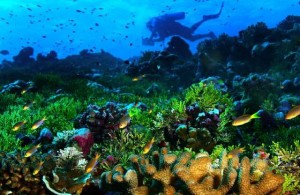
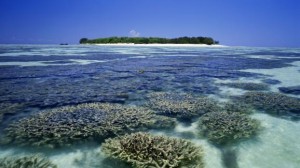
So what is being done to try and save these gifts of nature? One Tree Island is a small coral cay near the Tropic of Capricorn in the Southern Great Barrier Reef. It provides the setting for scientific research. Up to 20 visiting scientists conduct studies relating to reef and cay environments here. Without human disturbances, the purpose can be fulfilled so much easier and conditions are more of a natural state. It is a totally enclosed lagoon and the only one of its kind on the Great Barrier Reef. With a good variation in zonal characteristics, it makes for a better testing environment. At one point, tests were completed with placing dye in the water almost like antacid to promote growth. The organisms are then monitored at regular intervals and determine the success of this experiment.
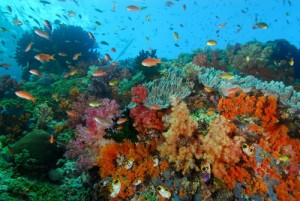
Then there is also Heron Island just off the northeast coast of Australia. You could say that this is nature at its finest. It is here that the Heron Island Research Center conducts research to determine the state of our reefs and where their fate may be headed. A coral reef is being recreated in tanks complete with mushroom corals and a variety of other species. The experiment is being led by Sophie Dove from the University of Queensland in St. Lucia.
Into one set of tanks, she has put seawater at the reef’s current temperature and carbon dioxide concentration. A second tank circulates water that’s somewhat cooler and has less carbon dioxide — conditions the reef experienced 100 years ago, before we started burning fossil fuels and pouring huge amounts of carbon dioxide into the atmosphere. Two final sets of tanks hold water that’s warmer and contains far more carbon dioxide than the oceans absorb today. These are glimpses into our perhaps not-so-distant future.
Dove opens up the first of these tanks — present-day conditions. The corals look like they came from a picture book of life on the reef. The second tank, pre-industrial, looks about the same, though Dove says those corals are actually growing faster and are healthier than those growing in modern-day seawater.
The third and fourth tanks are the shockers. Most of the corals have died in this “future” world. A gelatinous black slime floats across the top of one tank. Corals still hanging in there have lost the colorful organisms that live inside those calcium skeletons, so they are bleached white.
These are the types of investigations that are underway on a regular basis. There are also non-profit organizations that are continually dedicating themselves to the preservation of reefs such as Coral Reef Alliance and the Coral Restoration Foundation Bonaire. These types of groups work tirelessly to try to accomplish what is probably the most difficult task in the world today.
Ultimately, man is in charge of the destiny of our world. We must all do our parts to make sure that the magnificence of our coral reefs stay intact and begin to once again flourish and radiate colorful beauty as they were meant to do.
PHOTO CREDITS: Google Images



Comments are closed.