
EMPLOYMENT SITUATION FOR NOVEMBER 2013
By: Hope Wilkos, Writer/Blogger
As the holidays approach and retailers look to maximize their revenue for the year, the November Employment results were met with acceptance and promise that we will end 2013 on a high note.
The Manufacturing sector seems to be getting stronger along with auto sales but diligence continues to be necessary for those still out of work. President Obama is making a case for extending the emergency unemployment insurance before it expires at the end of this year. In addition, he is advocating higher wages, more mobility and expansion of educational opportunities.
Five key points were the takeaway from the statement put forth by Jason Furman, Chairman of the Council of Economic Advisers.
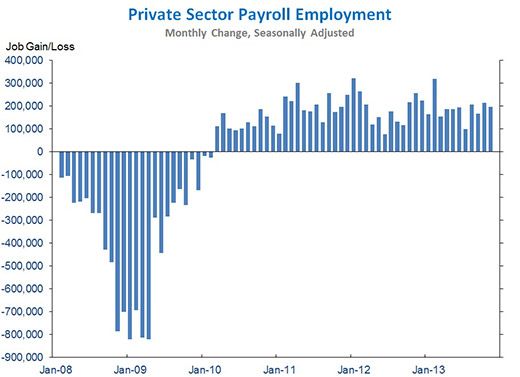
1. America’s resilient businesses have added jobs for 45 consecutive months, with private sector employment increasing by more than 8 million over that period of time. Nonfarm payroll employment rose by 203,000 in November of which 196,000 was in the private sector. September private sector job growth was adjusted to 168,000 and October was 214,000.
2. Real average hourly earnings for private production and nonsupervisory workers rose 1.4% in the 12 months which ended in October. This marks the largest increase since 2009. Statistics show that this growth will most likely continue. This wage growth that has been shown to take place recently reflects low inflation and a pickup in nominal wage growth. The average private sector production and nonsupervisory worker earned $20.31 per hour which is up 2.2% relative to last year at this time. The net increase in hourly earnings really only rose 3% since 1979 – a period when labor productivity rose by more than 90%. We must ensure that our economy strengthens.

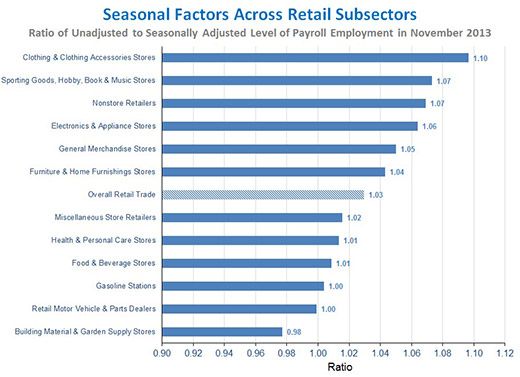
3. Many retailers have hired additional workers to assist during the heavy holiday traffic season but the magnitude of holiday hiring differs substantially across retail sub sectors. The chart below gives you a good idea of the variances. Clothing and clothing accessory stores had the largest increase in hiring displaying that the unadjusted employment was about 10% higher than the seasonally adjusted level in November. In stark contrast, for building material and garden supply stores, unadjusted employment was about 2% less than seasonally adjusted employment in November. With the frigid weather in many parts of the country, gardening is not high on the priority list for the winter months. The seasonally adjusted data is the best benchmark of the economy’s progress. Overall hiring in the retail trade sector has been solid in recent months, with employment rising by an average of 36,000 per month over the last six months.
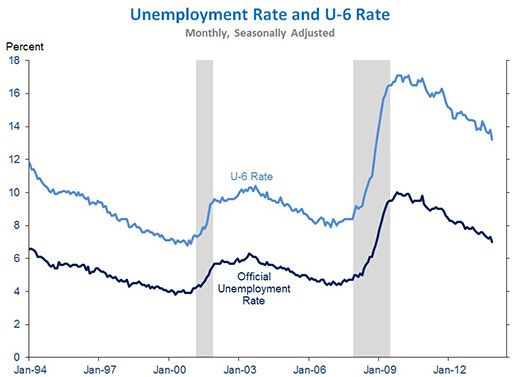
4. The unemployment rate fell 0.3 percentage points to 7.0%, the lowest in 5 years and the Bureau of Labor Statistics’ broadest alternative measure of labor underutilization also posted a notable decline. The study performed includes the unemployed, persons working part-time for economic reasons and those marginally attached to the labor force. The measure fell by 0.6 percentage points in November, the largest one-month drop on record (following a shutdown-related increase in October). Now it is at its lowest level in five years. This is a positive sign that the labor market is healing.
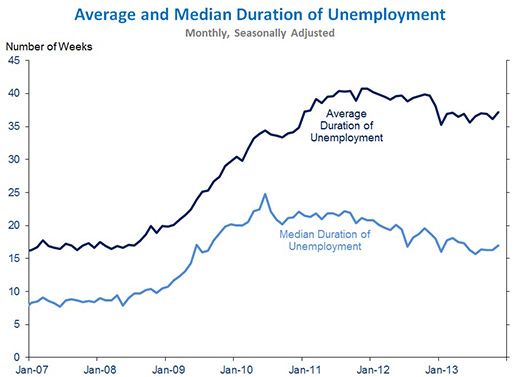
5. The complete reduction in unemployment in November was due to a drop in the number of short-term unemployed, while the average duration of unemployment rose to 37.2 weeks and remains elevated. The median duration of unemployment came down from the peak of 24.8 weeks to 17 weeks in November, but the average duration has not come down as much from its peak of 40.7 weeks. This gap is an indicator that many of the remaining unemployed are concentrated at extremely lengthy durations of unemployment. The additional weeks of unemployment insurance that is offered as a result of the Emergency Unemployment Compensation (EUC) program which was first signed into law by President Bush in 2008, serves as an important lifeline to those who are still struggling to get back on their feet during the crisis.
It is important to note that while we are very optimistic of a much better year to come in 2014, these results are very volatile and are subject to revision.
STATEMENT ISSUED BY JASON FURMAN, CHAIRMAN OF THE COUNCIL OF ECONOMIC ADVISERS


