
JANUARY 2014 EMPLOYMENT UPDATE
By: Hope Wilkos, Writer/Blogger
On the heels of the President’s State of the Union Address, the nation is looking to see how in 2014, the government will influence and guide positive change. President Obama continues to focus on action, warning Congress that he is willing to make sure that equal opportunity and job growth are stimulated by using his pen if necessary. A takeaway from the statement released by the White House Office of Communications was that businesses have now added 8.5 million jobs over the last 47 months and the unemployment rate has now dipped down to its lowest level in more than five years.

Five key points stand out from the January 2014 employment results.
1. The private sector has added 8.5 million jobs in 47 consecutive months of job growth. Nonfarm payroll employment rose in January by 113,000 which equated to 142,000 increase in private employment offset by a 29,000 decline in government jobs. Private sector employment has risen by 2.3 million (191,000 per month). The figures have been derived from some revisions inclusive of benchmarking the survey-based data to more comprehensive tax records, updating the seasonal adjustment factors and reclassifying a handful of industries.
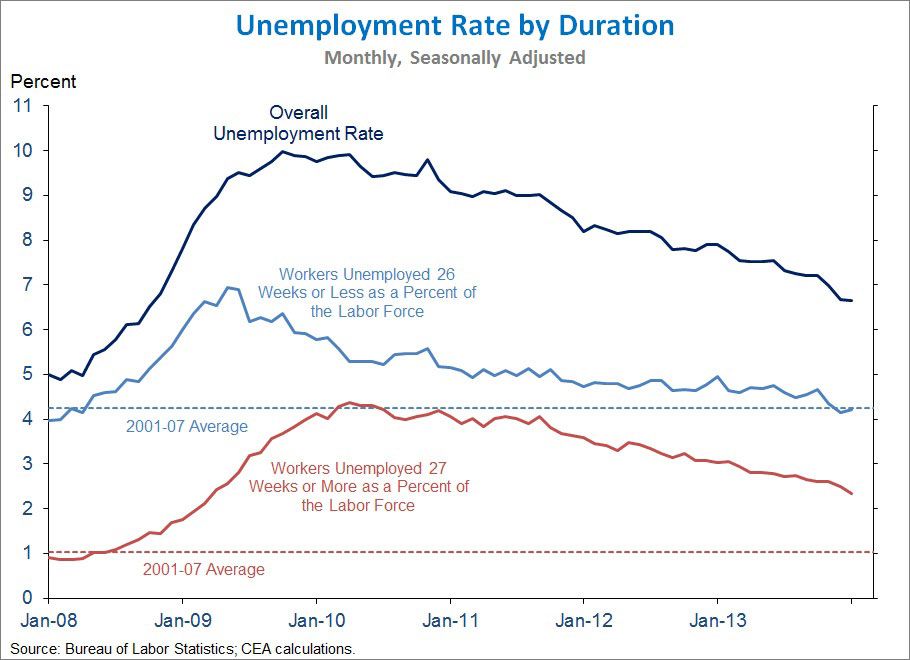
2. While the unemployment rate continues to fall, it is still too high, reflecting more than 3.6 million, long-term unemployed. The unemployment rate has fallen 1.3 percentage points over 12 months. In January, it fell a 0.1 percentage point but in January, it can also be said that persons unemployed 27 weeks or more represent 2.3% of the labor force, more than double its average prior to the recession. Many families are still experiencing hardships that need to be addressed. The only way to do this is for Congress to reinstate the extended unemployment insurance benefits that expired at the end of 2013, and in the absence of congressional action, the President has declared that he will use his own authority to forge ahead with efforts to help connect the long-term unemployed with new jobs. The President has committed to over 300 companies (including 80 of the nation’s largest businesses) that he will adhere to a new set of practices that will ensure recruiting processes do not disadvantage people who have been out of work, along with new funding for partnerships that connect the long-term unemployed to jobs.
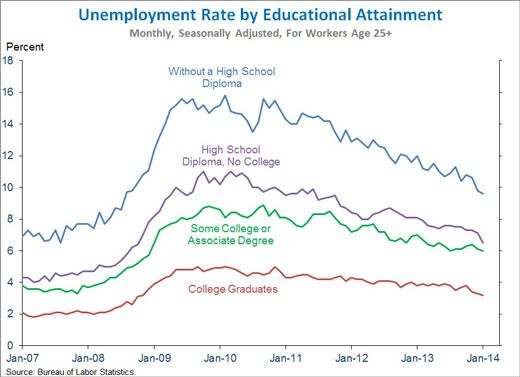
3. Unemployment rates continue to vary widely by educational attainment, from just 3.2% for workers (age 25+) who completed college to 9.6% for workers without a high school diploma. Going to college has a large economical benefit in the end as is evident from January 2014 results. The unemployment rate for workers who completed college was less that half the unemployment rate for workers who only had a high school diploma. Increased education leads to higher wages and substantially greater upward mobility. The President is continuing to work to make a college education more affordable and has made a commitment to more than 150 universities, businesses and nonprofits that he will assist in helping more low-income students access and succeed in college.
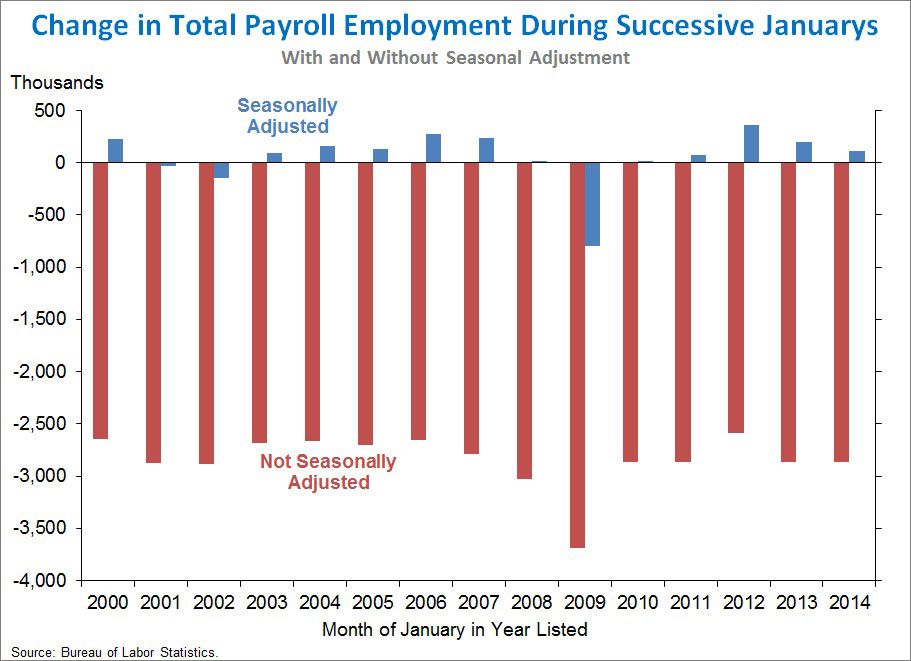
4. In January, the economy typically experiences the sharpest seasonal swing in employment, partly reflecting the unwinding of temporary holiday season retail hiring. As is customary, the January 2014 unadjusted employment fell by an average of 2.9 million, in line with the average for this time of year. There was a seasonally-adjusted increase of 113,000 jobs in total non farm payroll employment for January 2014. The fact that seasonality varies over time adds an additional margin of error to monthly estimates from the payroll survey.
5. Looking over the last 47 consecutive months of private sector job growth, the construction sector had its strongest single month of job growth in January 2014, adding 48,000 jobs. In retrospect, part of this strength may reflect a bounce-back from weaker job growth in December, when construction shed 22,000 jobs. In contrast, education and health services saw its weakest month of job growth over the last 47 months, with employment in this sector falling by 6,000 in January. Education and health services employment has increased by an average of 31,000 per month over the last 47 months, but has declined over the last two months. Taking into account other job sectors, manufacturing had an above-average month, adding 21,000 jobs in January, while the Federal government lost 12,000 jobs, near the lower end of its recent range.
While these results show that recovery is continuing to take hold of our nation, there is still much to be done to continue to get us on the right track and stay there.
STATEMENT RELEASED BY Jason Furman, Chairman of the Council of Economic Advisers



Comments are closed.