
CHANGES AND UPDATES IN THE WHITE HOUSE
By: Hope Wilkos, Writer/Blogger Photographer: George Whylie Videographer: Maxine NolanThe Obama Administration begins its 2nd term in office but we will be introduced to some new faces this time around.
Hillary Rodham Clinton is stepping down as Secretary of State. She can look back on quite a decorated path of achievements. Clinton became the first Former Lady to serve in a President’s cabinet. She strongly promoted the empowerment of women across the globe and made history as the most widely traveled Secretary in a term of office. She is currently the most popular political figure in the nation, quite a feat since her approval level when she entered office was as low as 40%.

But now Clinton gives up her seat to spend some much needed time with her family and she hands over her responsibilities to a name that we all know well. That individual is John Kerry. John Kerry is a five-term Senator and received no opposition to taking over this challenging post. The Senate overwhelmingly confirmed his appointment. U.S. Senator Joe Manchin released quite a complimentary statement this week, “Over four decades of public service, from the battlefields of Vietnam to the floor of the U.S. Senate, he has established his credentials as one of our country’s brightest statesmen.” Kerry is seen as an exemplary leader and very capable of stepping right into this important role. In fact, nations such as Russia welcome the appointment of Senator Kerry and they know that he brings a wealth of experience with him.
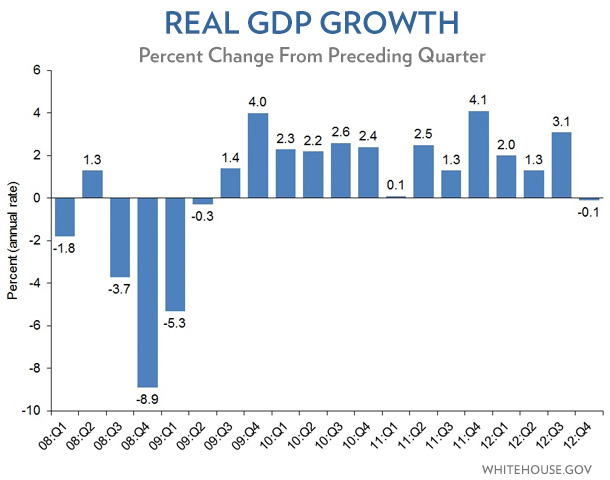
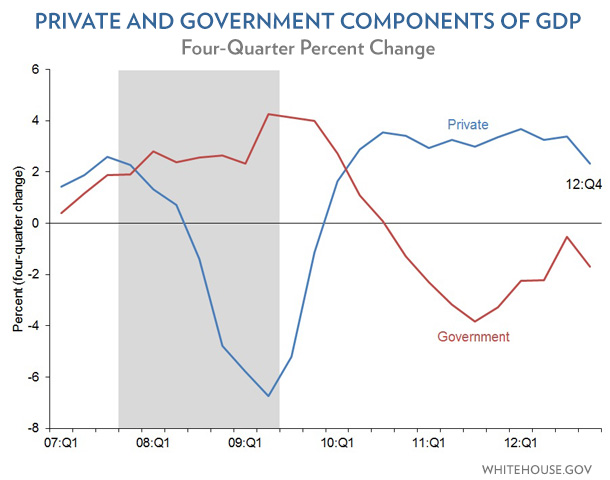
On January 30, 2013, the advance estimate of GDP for the fourth quarter of 2012 was released by the Bureau of Economic Analysis. The GDP dropped 0.1% at an annual rate marking the first quarterly drop in real GDP in 3 1/2 years. This was amidst signs that Hurricane Sandy disrupted economic activity and Federal defense spending declined precipitously, likely due to uncertainty stemming from the sequester. Over the last fourteen quarters, the economy has expanded by 7.5 percent overall, and the private components of GDP have grown by 10.9 percent. During the four quarters of 2012, real GDP grew by 1.5 percent, the third consecutive year of economic expansion. Over this period, real GDP growth has been led by an expansion in the private sector.
On an upswing, personal consumption expenditures (the largest component of GDP) increased by 2.2% at an annual rate in the fourth quarter of 2012. The previous quarter had recorded 1.6%. One of the most consistent increases came from residential investment, a growth of 15.3%. The fastest growth came from business investment in equipment and software which rose by 12.4%.
On the downswing, federal defense spending declined at an annual rate of 22.2% in Qtr 4 2012, the largest quarterly decline in 40 years. The decline in government spending across all levels reduced real GDP by 1.33 percentage points in one quarter.
As the year 2012 came to a close, Hurricane Sandy had disrupted lives and there was much financial unrest with uncertainty of going off the fiscal cliff. But the passage of the American Taxpayer Relief Act in early January eased some of the worry. One of the top priorities that Congress should concentrate on is moving towards a sustainable federal budget in a responsible way to balance revenue and spending, replace the sequester and make critical investments in the economy to promote growth and job creation and protect our most vulnerable citizens.
Just today, the much anticipated status on the employment situation in January was released by Alan B. Krueger, Chairman of the Council of Economic Advisers. It appears that the economy continues to teeter on the edge as we saw a small increase in the unemployment rate from 7.8% in December to 7.9% in January. The labor force participation rate remained unchanged at 63.6%.
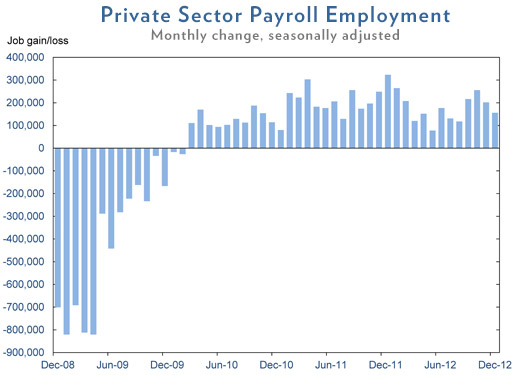
Private sector jobs have been added for 35 straight months and a total of 6.1 million jobs were added over that period. Businesses added 166,000 jobs in the private sector in January. Total non-farm payroll employment rose by 157,000 jobs. The average first report of monthly job growth in 2012 was 142,000; that is now revised up to 181,000 jobs per month.
In January employment rose notably in retail trade (+32,600), construction (+28,000), health care and social assistance (+27,600), professional and business services (+25,000), and restaurants and bars (+17,100). Manufacturing gained 4,000 jobs in January. The manufacturing sector has added about a half-million jobs over the last three years, the most for any such period since 1996. Also of note, in the last two years the construction sector has gained nearly 300,000 jobs, with one-third of that gain occurring in the last four months. Government lost 9,000 jobs in January, including 5,000 Federal government jobs, and 4,700 jobs in local government education. The local government education sector has now lost 339,400 jobs since its recent peak in November 2009.
As we begin another month in 2013, the Obama Administration must work together to work towards keeping the economy on an upward swing and reduce the fears of Americans by promoting the creation of jobs. President Obama continues to make this one of his top priorities and addressed this topic in his weekly address.
STATEMENT RELEASED BY THE WHITE HOUSE


